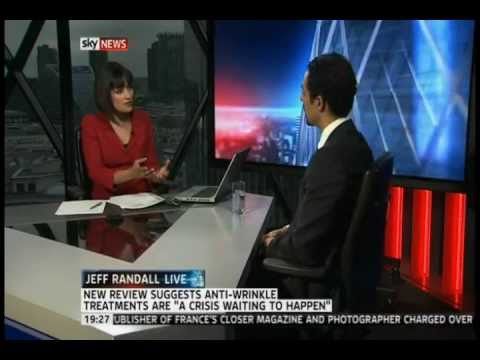
Now Britain's most senior doctor has called for a crackdown on the multibillion pound UK cosmetic surgery industry. An independent review chaired by the health services Medical Director says, "Some dermal fillers are less regulated than toothbrushes or ballpoint pens." He described the procedures as "a crisis waiting to happen." Well Sir Bruce Keogh report also criticizes reality shows like The Only Way Is Essex for trivializing cosmetic surgery. Well, from Botox to breast implants the cosmetics procedures industry is booming. In this country alone the sector has ballooned from being worth ?720 million per year in 2005, to ?2.3 billion in 2010. The industry is forecast to be worth more than ?3.5 billion in the UK by 2015. The strongest growth has been in non-surgical procedures such as fillers and Botox, to tackle wrinkles and laser hair removal which were described as "almost entirely unregulated". Our health correspondent Thomas Moore has more. Well, basically he hit a vein here when he injected around this area, now I still have numbness, tingling, burning. More than a year after having injections, to plump up her face and make her look younger, Mary Catchpole is still suffering from serious side effects. She'd wanted dermal fillers to look her best on her wedding day. But she felt so ill that even now she can barely look at the photos. The chemicals had got into her bloodstream affecting her whole body causing a rash on her legs and stomach. I have no memory of my wedding day just continuous insomnia, disorientation, memory loss. I started to have hearing loss, incontinence, forced on weight loss in 3 months, a psoriatic type rash that developed all over my body, on my face. You know devastating sort of. At one point I was in a wheelchair. I couldn't actually walk. I couldn't get out of bed. A major review of the cosmetic surgery industry led by the NHS medical director warns that dermal fillers are a crisis waiting to happen. It says fillers are as lightly regulated as toothbrushes, yet they can cause serious side effects and should be on prescription. At this clinic the injections are only given by doctors. The practitioner has to inject in the face, and I'm sorry but I cannot accept that the practitioners that do that after they have done 1, or 2, or 3 day courses really are familiar with the anatomy. So this is really the problem. The cosmetic surgery industry in Britain is now worth ?2.3 billion a year and it's still growing. 90% of procedures are non-surgical largely Botox or filler injections. 190 different dermal fillers are available in Europe. In the US where they have to pass stricter safety checks, it's just 14. This beauty salon features in the TV show The Only Way is Essex. Surgeons have warned celebrities are trivializing serious medical procedures. But the owner says the new rules would wrongly target clinics who employ doctors and nurses to give the injections. Because people can still get all of these dodgy products off of the internet. They can go set up in a room, in a house, anywhere, in a caravan if they wanted and still do these procedures. How do you stop that? You can't legislate against that. The new proposals for tightening up the cosmetics surgery industry follow the PIP breast implant scandal. The Department of Health says patients need protecting and will announce what action it will take later this summer. Thomas Moore, Sky News. In here at the Gherkin is Dr. Julian De Silva a Cosmetic Surgeon with 2 practices in London. It's great to have you with us tonight Dr. De Silva. - Thank you. - First of all give us an idea about the size of your business and the kind of procedures which are very popular. So I specialize very much in the face. So the 3 principle areas that I help patients with are eyelids and blepharoplasty, nose reshaping rhinoplasty and the face and neck lifting, those techniques. I can tell you just specializing in that one area in the body it requires a great deal of skill and technique in order to keep up to date with all the advances. There's continual evolution in medicine. Where we were 5, 10 years ago is not where we are today. As your graphics illustrated the cosmetic industry has changed dramatically in the last 10 years. Non-surgical treatments, Botox and fillers, were not nearly as accessible, and many didn't even exist 10 years ago. This is a continual evolution. Do you think that regulation therefore is the answer here? Well, I think the unfortunate woman that you've shown in your story, and that's definitely a tragic story. The reality is that she's really a minority, and there's a great deal of many many happy patients who've had non-surgical treatments that are both safe, have given a good result. Patients actually come back for even more treatments. Because Botox and fillers although they are treatments that are very effective, they often have a relatively short duration. So after 6 to 12 months many of those treatments need repeating. The proof is there. If patients were not genuinely happy with their treatments, they wouldn't keep coming back for further treatments. But it's more than being happy, isn't it? I mean we saw there the extreme damage and distress that have been inflicted upon that patient. And you know we all hear about Botox parties, and less than qualified practitioners, that we'd say, who set up on their own and offer fillers. A lot of these fillers we're not entirely sure about their safety. I mean you only have to look at breast implants scandal to see that. So surely there must be a need for more here. I think you're absolutely right. I think when we look at things what this is really about, it's about individual people. It's about patients and safety should always come first before anything else. It's easy to get distracted about that looking at market figures, looking at glamorised TV shows. But actually it's a very individual decision to have any kind of treatment. I know that with every patient I treat I spend more than 2 hours with every patient before I contemplate doing surgery on them. That's so I really know exactly what they want, what that patient's expectations are, and also give them an idea of what those risks are. If I was to give you one example, eyelid surgery, or also known as blepharoplasty is the most common cosmetic surgery in the world. - Yes. - It's regarded as a relatively safe procedure. However, there is a tiny chance, a less than 1% chance of blindness after blepharoplasty. I tell every individual patient that there is a tiny risk of this happening. Of course there are steps you can take to reduce this, to minimize it. However, at the end of the day surgery is surgery, and occasionally unexpected things occur. I think that's when we're talking about regulation, we're talking about training staff whether they're doctors, whether they're nurses or other individuals, so that they are aware of the potential risk of doing some of these procedures. The chance of having complications from a Botox or a filler is relatively very small. However, if you don't understand or appreciate the anatomy of the face, or the potential risks then there's definitely a call for further regulation to help with that. Okay, Dr. Julian De Silva great to have you with us tonight. - Thanks for joining us. - Thank you.